
Exploring Faith in Bath and Bristol: A Year 10 P&R Trip
Article by Emily Nelson, Year 10
Bath Abbey: History and Faith
We began the day in Bath, the coach winding steadily past the stone buildings, surrounded by beautiful architecture and history. Our first stop was Bath Abbey, with half the group taking part in a talk by a young volunteer who shared her experience of faith since childhood. The other part of the group did a tour of the Abbey with their guide and one of the assistant priests, so we learned about the historical and religious aspects of the building and also of the work of the church in the local community. The groups then swapped over, ate lunch together, and we walked down the road to the Manvers Street Baptist Church.
Manvers Street Baptist Church: Community in Action
The church there was very strong in community spirit, with people from all walks of life meeting there – from refugees to past alcoholics – and the church felt welcoming to people no matter the reason. Once sat in the pews, we received a talk from the pastor of the church, Andy Percey, who told us about his church’s work in the local community, from baptisms to the building acting as a meeting point for various groups in the surrounding area.
A local street pastor also talked to us about his role in the local community, helping keep people safe on a night out. His group of street pastors hand out flip flops, energy bars, hot drinks and find safe transport for those who need it – he felt this was his mission both from God but also personally to make his local area safer.
After thanking both the street pastor and the pastor (and after a couple of people buying som cake from the small café they have at the church that provides job opportunities to disabled people in the area), we all piled into the bus and made the 30-minute drive to the mosque in Bristol.
Easton Jamia Mosque: Islamic Practices and Beliefs
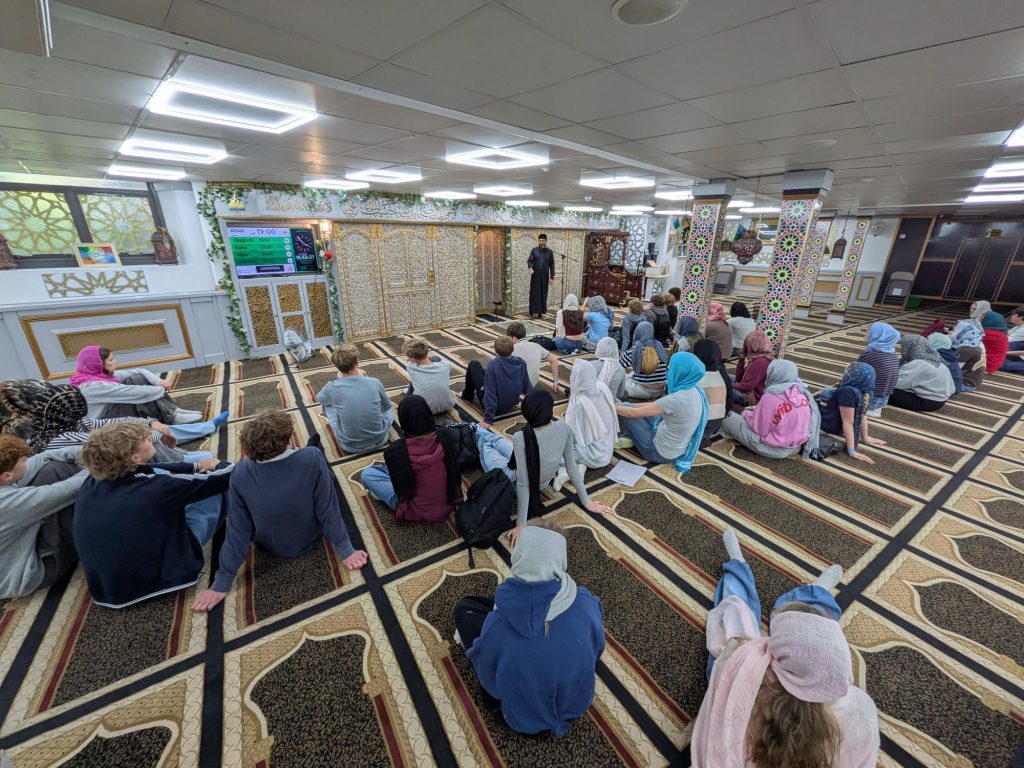
After arriving and girls putting on headscarves, we walked down the street to the Easton Jamia Mosque where we were welcomed by the Imam (leader). The building was beautiful, with ornate prayer mats on the floor and gold detailing across the walls with the Qiblah wall pointing us in the direction of the Ka’bah, which all Muslims must pray towards.
He then talked us through a PowerPoint of the key Muslim practices and beliefs – for example, the 5 pillars of Islam (Shahadah, Salah, Sawm, Zakat, Hajj) and went into detail about each one. He himself has not yet gone on the full pilgrimage to Mecca as all Muslims must do once in their lives, but has completed the Umrah (a smaller half pilgrimage) with his family. We then all prayed together towards the Qiblah wall (and Mecca), with the Imam stating the Shahadah (Muslim belief statement) for us in Arabic.
The Prayer Rooms: Men’s and Women’s Spaces
We then travelled up a winding staircase to the women’s prayer area, since men and women pray separately to avoid distraction. Above the room was a huge stained-glass dome, sending colours bouncing around the room and reflecting on the gold details. The carpet was gold and burgundy, made up of countless prayer mats so the women in the community can pray together.
We then went through a small door to the men’s room, which was the same as the women’s, just slightly bigger (as more men pray at the mosque) with a similar dome above. Finally, we all went downstairs and were lucky enough to hear the Imam recite the Azan (call to prayer). We thanked the Imam and travelled back to school.
It was an amazing trip that was both fun and a great asset to build on past knowledge, and I’m sure that any of us students on the trip would recommend it to anyone in the future.