

Computing News term 4 2022/23
St John’s students win Cyber Challenge

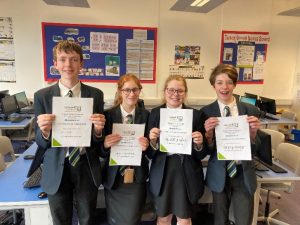 On Tuesday 14th March three teams of Year 8 students took part in the Unlock Cyber Challenge, run by Immersive Labs.
This involved a two hour online competition, where students played the role of a cyber detective, attempting to track down online criminals using advanced cyber forensics tools.
The students put in a number of hours, both during and after school, learning how to use the various tools and running through practice labs where they got to try out the tools, before putting them into use on the big day.
According to Maja, “I signed up to the competition because I’m interested in computing and want to learn more about it, and because I’m thinking about a job in computing in the future. The competition was really exciting, especially when we solved a problem and managed to answer it correctly!”
We’re delighted to announce that Team Fruit Salad won the challenge, finishing first out of nearly 40 teams across the South-West.
The team was made up of Arthur Ramsden, Maja Porebska, Nicolet Pegler and Henry Mann, and they’re really looking forward to receiving their prizes (which may well include air-pods!).
CanSat – Team Astraeus

 After a last-minute change in dates, due to inclement weather, Team Astraeus, the St. John’s CanSat team (made up of Alf Twisk, Christopher Cowlan, Jack Santiago and Toby McKay) ventured out to COTEC’s ordnance testing facilities on the Salisbury plains to launch their prototype satellite and test out their experiment.
The experiment involved using various sensors all crammed into a “satellite” no bigger than a drinks can, to capture environmental information about an exoplanet, in order to grade the planet on its habitability. This information had to be sent back to a base station, wirelessly, where it would be displayed on a screen. The other important aspect of the experiment was to ensure that the CanSat returned safely to Earth after having been deployed by the rocket.
After some initial problems with the strong winds necessitating a reduction in the parachute size, the team were able to complete a successful launch and capture lots of interesting data as their satellite fell back to Earth. One example of that data was the particulate matter generated by the rocket as the CanSat was launched.
 The graph across shows the spike in particulates as the CanSat’s altitude increased, before returning to normal as the CanSat fell back to Earth – indicating that it wouldn’t be very habitable to live in the exhaust stream of a rocket.
FIRST Tech Challenge – Team Horizons
 In an exciting competition, new to St John’s, year 10 students have been taking part in the FIRST Tech Challenge – where they have to design, build and program a robot to compete against other robots in the Raytheon Technologies PowerPlay challenge.
This project has proven a real challenge to the students – they have had to work really hard as a team, establishing engineering sub-groups for drivetrain, lift and intake, coding sub-groups responsible for autonomous control and manual control, and teams responsible for outreach, social media, fundraising and project management.
As we approach Easter, one-term away from the competition, the team are feeling really positive. They have a functioning robot that can carry out the core mission, and are now in the process of fine-tuning the mechanical aspect of the project to make it more robust and reliable and enhancing the coding aspect to improve manual control and implement more successful autonomous control.
 Here’s a sneak peek of what “Team Horizons” have built so far. If you’d like to find out more, follow them on Twitter
  @StjHorizons